Tuesday, June 17, 2025
Every unforgettable story shares one hidden truth: transformation begins at the moment of collapse.
I didn't fully understand this until I discovered Will Storr's concept of the theory of control, an idea that reshaped how I view storytelling. At the core of every great character is a flawed belief about how the world works. It’s how they think and navigate reality.
What's powerful about this lens is what it exposes: characters don't change because they learn something new, they change because their existing belief system breaks.
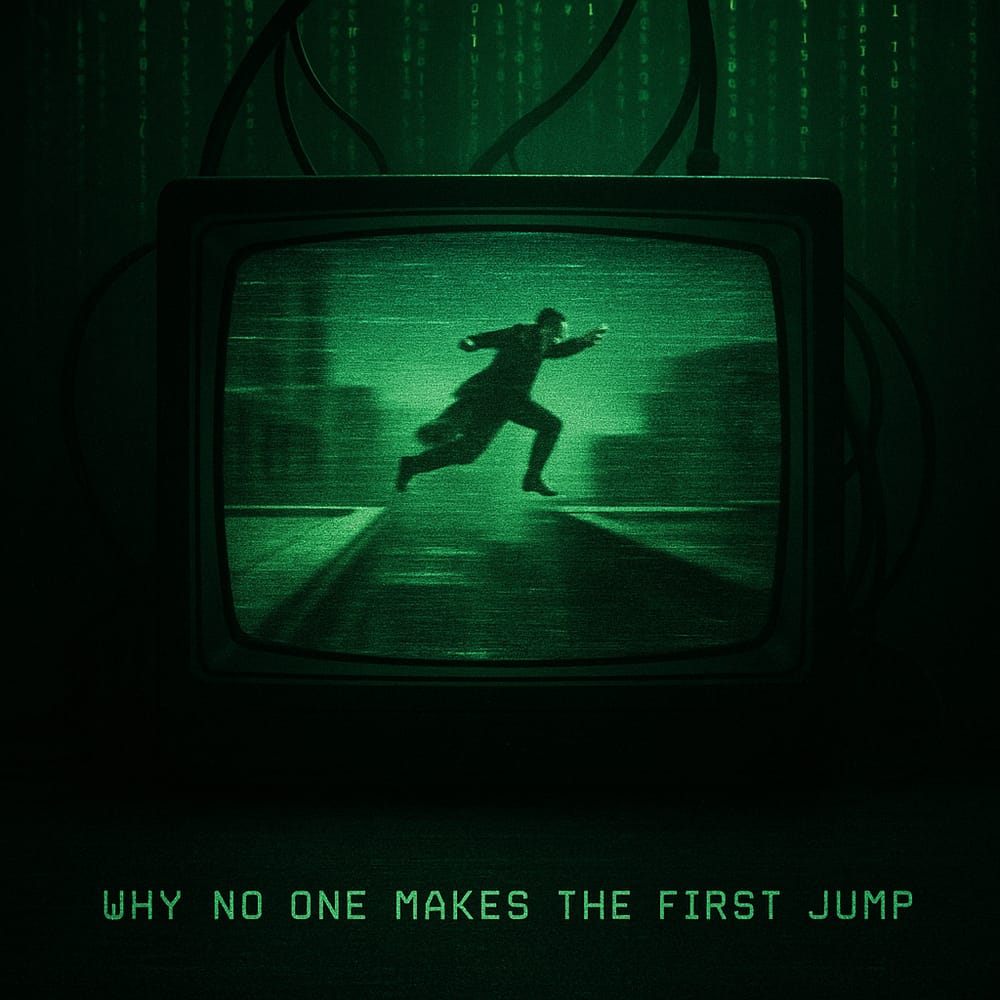
Nowhere is this clearer than in the Matrix when Neo fails the jump test. A moment where his body hits the ground, but his illusion of control hits harder.
I. The Lie Beneath the Character
This idea comes from Will Storr, author of The Science of Storytelling, in an interview with David Perell on the podcast How I Write. They discuss storytelling through character, not just plot or structure,and a concept I had never heard of: the theory of control.
Storr argues that at the heart of every story lies a character's flawed belief about how the world works that guides a character's actions. Internal rules drive these great characters. This theory of control helps them pursue what the brain evolved to want: survival, status, or connection.
You can think of the brain as a machine for controlling the world: a prediction engine wired to avoid pain and seek reward. A story is not merely a series of events or a timeline of occurrences; it is about the transformation of a character.
For me, this idea is one of the most important discoveries I've made as a writer. It changed how I think about narrative and gave me a deeper, psychological approach to storytelling.
When I used to create characters, I'd start with surface traits—their age, ethnicity, how they dress, what music they like, what they do for work. I thought that mattered. I'd stack quirks, layer backstory, write flashy lines that sounded clever, but went nowhere.
None of it moved the story. Not unless it revealed, challenged, or affirmed their theory of control—the flawed belief that shapes how they see the world.
It was easier to write about externals. That's why I did.
It reminds me of what Aaron Sorkin said: "I worship at the altar of intention and obstacle."
That hit. Because it maps perfectly onto Storr's theory of control. Underneath every compelling character is a flawed belief, and a desperate need to make the world fit that belief.
If a character believes they're good, unlike their criminal family, then everything they do is an attempt to prove it. That's intention. But the world pushes back. That's obstacle. And the friction between the two is where the story lives. That’s what makes the Godfather movie so compelling.
It's not the details that make a character memorable.It's the belief they refuse to let go of, and what finally breaks it.
I've spent years learning about story mechanics to improve my skills. I believe writing is the core skill that sharpens thinking, strengthens communication, and holds great power in life and business. Through writing, we become better storytellers. Storytelling is our shared birthright, transcending time, culture, and logic. It helps us bypass rational defenses and reach deeper truths.
Like Neo, I am trying to understand the rules, so I can control it. Storytelling cuts through noise. It persuades, connects, and endures. As Robert Rodriguez suggests, 'committing to a body of work' sharpens your instincts. To create lasting work, you must uncover the truth beneath the surface and weave it into fiction.
This is where Storr's framework shines. In his book, The Science of Storytelling, he makes a psychological case that change is infinitely compelling to our brains. We're prediction machines after all. We crave stories because we crave models for change.
Now, back to the theory of control.
This concept captivated me because it explains why stories resonate. It deals with a character's flawed sense of self, their illusion of control over their world, and how that illusion must collapse for transformation to occur. In other words: by the end of the story, the character must change in some way.
To illustrate this, I'll use a film that resonates deeply with me: The Matrix.
I've loved this movie for years. Recently, I understood why it resonates with me and millions of others over the past 25 years. We still reference it, using the red-pill-blue pill metaphor as a shorthand for choosing painful truth over comfortable illusion. We turn to "glitches in the Matrix" when reality seems to hiccup. The film has filled our collective consciousness in ways few stories achieve.
How has it grown more relevant as ideas like simulation theory and artificial intelligence become mainstream?
Because The Matrix speaks to the human condition. It dramatises the collapse of a flawed belief system. It reveals a universal truth through fiction, which is why it works.
As Neil Gaiman and other great storytellers say, fiction is a lie that tells the truth. Films like Harry Potter, Star Wars, and The Matrix last because they show real, inner feelings. They resonate with what we suspect about ourselves.
Joseph Campbell showed us the outer journey. Will Storr and this theory provide the inner map. The hero's "ordeal" isn't just facing danger; it's also about facing themselves.
A Story of Choice and Reality
The Matrix asks: What do you do when you find out your whole reality is fake? This is not just sci-fi talk, it's a deep question we all confront during moments of clarity.
At its heart, the film presents us with a choice: the comfortable illusion of the blue pill or the painful truth of the red pill. This choice is a direct challenge to Neo's theory of control. He believes the truth will set him free. So, he chooses the red pill. This choice creates the perfect conditions to test his beliefs.
This choice-driven narrative mirrors our own struggle with reality. Our choices shape our identity and beliefs. It's our responsibility to use our free will to build a reality that shows our true selves. The Matrix shows that our idea of choice might actually be part of the system that controls us.
Neo's jump in The Matrix shows that real character change happens when a hero's core beliefs about reality collapse. Writers who begin with a character's flawed control theory, instead of just focusing on plot points, craft stories that resonate more. These stories reflect how people really change.
II. The Jump The Breaks the Hero
Neo's theory of control: "I'll be free if I find the truth."
In the Matrix, Neo starts as Thomas Anderson. He is searching for answers outside himself. But each scene introduces resistance to his belief that knowledge leads to freedom.
His inciting incident arrives with a choice: blue pill or red. He chooses the truth. But that truth shatters him. He wakes in an alien pod, bald, alone, and baptised into horror. Truth is supposed to feel like freedom but, instead it feels like death.
The first sign of trouble in his control theory shows up in the Oracle's waiting room.
There, a child bends a spoon using just his mind.
"Do not try to bend the spoon," the child says. "That's impossible. Instead… realise the truth: there is no spoon."
Reality is not physical.
Reality is mind-made.
Later, in the dojo, Neo fights Morpheus using technique and logic. He fights by invisible rules.
Morpheus challenges him: "You think that's air you're breathing now?"
But nowhere is this theory tested more viscerally than in the rooftop-jump scene.
And the crew of the Nebuchadnezzar gather like ghosts in a cathedral of wires and sparks, faces lit by terminal light, waiting, not watching - waiting, because they’ve all done it, all tried and failed and fallen, and even the name of the ship matters, god it matters. Nebuchadnezzar, the mad king who lost his crown, his mind, his name before he could finally see, and isn’t that what it takes—losing your grip, your lie, your precious illusion.
Because they too were once sedated in dream machines, tucked in tight by comfort and calendars and soft routines and fluorescent safety, and now they fly not just through air but through belief, through broken myths and shattered narratives, the ship not a ship but a coffin for what died and a cradle for what’s waking.
And Neo, our saviour, The One (maybe), stands at the ledge of his mind, of everything he still thinks is real, still thinks he can control if he just learns enough, masters enough, memorises the rules and hacks the code and breathes the right way. The jump doesn’t care about any of that, the jump doesn’t care about skill or strength or logic or kung fu, the jump is the test of surrender, the test of letting go, the test of belief, and this is where his theory cracks, breaks, burns—“If I find the truth, I’ll be free”—but the truth is just another cage if you still carry the map, still cling to the system, still think understanding will save you, but it won’t, because the Matrix isn’t defeated by mastery, it’s defeated by faith, by the fall, by hitting the bottom and realising that only the ones who stop trying to win are the ones who finally fly.
Then it happens.
Morpheus doesn't hesitate.
He turns and launches off the rooftop like it's nothing.
One smooth motion.
No calculation, no fear.
He lands clean on the opposite skyscraper.
Effortless.
Now Neo steps up.
This is the moment.
The test.
If Neo makes this jump, the unspoken hope hanging in the air becomes real.
He runs.
Then leaps.
And for a second—just a second—it looks like he's going to do it. There's lift.
He believes and maybe we do too.
Then it breaks.
Midair, doubt hits.
You see it on his face.
Something slips.
His old model, the rules, the physics, the need to control, floods back in.
And down he goes.
He crashes through the ground with a thud that feels heavier than gravity.
The taste of metal in Neo’s mouth stamps a failure on this test.But, the injury doesn't matter, not really.
The body isn't real.
But the pain is.
Because he believed it.
And that's the point.
Neo's theory of control is shattered.
He found the truth. He knows this world is fake.
But his body still obeys the lie.
His mind hasn't caught up.
He's not trapped by the Matrix anymore.
He's trapped by belief.
Neo's faith failed him.
The difference between mind and faith is the difference between floating and falling.
Why does this moment matter so deeply?
Because it reveals a fundamental truth about human psychology: our resistance to transformation comes not from lack of information, but from our brain's desperate attempt to maintain control.
We cling to old models even when intellectually we know they're false because certainty, even flawed certainty, feels safer than the void of not knowing.
Transformation only begins when knowledge fails.
This moment reveals why Neo's journey resonates so powerfully with audiences: we all know what it feels like to "know better" yet still fall.
Our bodies and emotions often lag behind our intellect. This gap—between what we know and what we embody—is the battleground where all meaningful change occurs.
This moment reflects a universal pattern in stories that matter most, particularly those focused on transformation. While not every story requires psychological collapse, the most enduring do.
We don't remember characters for what they achieve.
We remember them for what they survive losing.
That's why no one makes the first jump. Not because they're slow or weak, but because letting go is harder than learning. The mind clings, and the ego fights, and transformation waits on the other side of surrender.
The jump scene isn't just a moment of failure, it's the essential visualising of what happens when a character's entire operating system crashes.
Neo doesn't just fail to leap between buildings; his fundamental assumptions about reality, control, and self-identity slam into concrete alongside his body.
Beyond the Jump
The jump scene becomes even more powerful when we follow Neo's full transformation arc through the film. His development follows the exact pattern that meaningful character change requires: After his spectacular failure, Neo visits the Oracle, still seeking external confirmation of his potential. She denies him, not out of cruelty, but because his theory of control ("someone else can validate my truth") must be completely dismantled.
The Oracle tells him, "Sorry, kid. You've got the gift… but it looks like you're waiting for something." This interaction is brilliant because it reinforces Neo's flawed theory, that he needs external validation, a fundamental misunderstanding of how true power works.
As the Wachowskis' screenplay notes, "Neo thinks being told he's The One is the truth he needs," but the Oracle's lie "forces Neo to act without certainty." Her deception is a necessary step in breaking his dependence on external validation. She understands that the only way Neo can truly transform is to act from belief, not knowledge.
Later, when Agent Smith shoots him in the hallway, Neo experiences literal death. A necessary death of his old self, the Thomas Anderson who believed understanding would save him.
This death creates the space for rebirth. Trinity's declaration "You are The One" beyond the romanticism, is his new theory of control being born: "Belief, not knowledge, creates reality."
In the film's climax, Neo completely embodies his new operating system by stopping bullets.
He no longer tries to understand the code, he is the code. His transformation is complete not because he learned more facts about the Matrix, but because he surrendered his flawed theory of how control works.
This final moment captures what the filmmakers intended as "the visual metaphor of control:" Neo "no longer dodges bullets. He rejects their premise. He's no longer reacting to reality. He's rewriting it. No fear. No doubt. No need to know. Just trust. Just choice."
III. The Control Collapse Framework
Neo's failed jump is a storytelling blueprint, showing us that transformation doesn't come from growth, but from collapse. From the violent failure of a character's internal model of the world.
This insight challenges conventional wisdom about character development. Most writing advice focuses on external journeys, arcs of accomplishment, or progressive learning. But the most powerful transformations occur when a character's psychological foundation (their theory of control) completely fails them.
Unlike character templates or beat sheets, the theory of control focuses on the one thing that drives authentic transformation: the destruction of a lie the character lives by.
Here's how to use that in your own work.
The control Collapse Framework
Stage 1.
Establish the Illusion
Your character has a belief that "works"—for a while. → "If I find the truth, I'll be free."
Stage 2
Test Through Action
They act on it. It seems to work. But then… it doesn't. → Neo jumps and his mind doubts and he falls.
Stage 3
Spectacular Failure
The belief must break—viscerally. Public. Painful. → He slams into the pavement. Their theory dies. Marks a sudden reversal: from belief to disbelief, from hope to failure, from ascent to violent descent. That’s classic Peripeteia: a sharp, irreversible turn in the character’s fortune or understanding.
Stage 3
Spectacular Failure
A new belief emerges → Neo stops bullets by letting go, not by knowing. This is Anagnorisis — the moment of deep recognition that transforms Neo.
What makes this framework so powerful is how it mirrors actual psychological transformation.
Our brains are wired to preserve existing models of reality, even in the face of contradictory evidence.
Psychologists call this "cognitive dissonance"—the discomfort we feel when new information threatens our worldview. Our first response isn't to change our beliefs; it's to reject, rationalise, or reinterpret the information to protect our existing theory of control.
This is why true transformation is so difficult, and why it makes for such compelling storytelling. The brain will defend its control theories until they catastrophically fail. Only then does change become possible.
The Theory of Control Worksheet
What does your character believe will give them control? → "________________________________________________"
Why is this belief flawed? → "________________________________________________"
Design a 'jump scene' where this belief fails spectacularly: → "________________________________________________"
What new truth replaces the old belief? → "________________________________________________"
What visual metaphor shows this transformation? → "________________________________________________"
What Happens Without Collapse?
Too often, stories are full of motion but empty of meaning. Spectacle without change. Action without arc.
Jurassic World: Dominion is a recent example. Dinosaurs run amok while the city falls. But what belief does anyone lose? What flawed theory breaks? Characters react, but no one transforms, and so it's forgettable.
This pattern explains why so many big-budget sequels fail to capture the magic of their originals.
The Matrix Resurrections, for example, struggled precisely because Neo had already completed his transformation. His theory of control had already collapsed and been rebuilt. Without that psychological engine, the action, however spectacular, lacks emotional gravity.
We see this same issue in countless other sequels. The original Die Hard showed John McClane's transformation from cynical cop to heroic saviour as his theory of control ("I can protect myself by staying detached") collapsed. But subsequent films (except Die Hard 3: With A Vengeance) lacked this fundamental psychological journey, becoming exercises in spectacle rather than transformation.
Similarly, the first Terminator film transformed Sarah Connor's belief that she was an ordinary woman into the realisation that she was the mother of humanity's future salvation. Later films struggled to find as compelling a transformation.
Audiences don't remember how many explosions a story had. They remember how it made them feel, and that feeling is transformation.
Without a flawed belief to collapse, there's no emotional gravity. Just noise.
Why We Cling to Our Theories
Understanding why characters (and people) resist change deepens our ability to write transformation convincingly. Our theories of control aren't just intellectual constructs, they're survival mechanisms.
The brain evolved to predict what will happen next. Our theories of control are prediction engines that help us avoid pain and seek reward. When these theories are threatened, our brains respond as though our survival is at risk, because from an evolutionary perspective, it is.
This explains why Neo hesitates mid-jump. His rational mind has accepted that the Matrix isn't real. But his limbic system, the older, survival-oriented part of his brain, hasn't. It screams: "Gravity is real! You'll die!" This internal conflict is dramatised perfectly in his facial expression as doubt creeps in during the jump.
This same mechanism explains why transformation is so difficult in real life. We cling to familiar pain rather than risk the unknown. We stay in dead-end jobs, toxic relationships, or outdated beliefs because our theories of control, however flawed, provide the illusion of safety.
Writers who understand this psychological reality create characters whose resistance to change feels authentic. Their reluctance roots to a neurological truth.
Why This Matters Now
We live in an age of uncertainty. AI, identity, ideology and our realities are shifting faster than we can process them. And in that chaos, stories become maps sugarcoated as entertainment.
The most powerful stories entertain, and they prepare us psychologically for the collapses we might face. They remind us that when our personal theories fail, transformation becomes possible.
This is why Neo's journey resonates more deeply today than when the film first released. In a world where reality itself seems increasingly malleable, his path from knowledge-seeker to reality-maker feels prophetic.
The Wachowskis' film poses a question that grows more relevant with time: "Do you ever feel like you're stuck in the same day-to-day routine, and that something is missing?" This question speaks directly to the universal feeling of limitation that Neo experiences, the sense that there must be more to life than what we're experiencing.
The Matrix seduces with code and silence and black sunglasses: What happens when you find out your whole world is a construction? Not just bricks or wires but thoughts, beliefs, frameworks built on frameworks, illusions stacked like poker chips in a rigged game, and Neo, our digital monk, our mirror, our messiah, answers with a leap, with the letting go, because the answer is a fall, and the real red pill isn’t knowledge, it’s death—death of the old story, the old self, the old rules you thought would save you, and that’s what makes it holy, that’s what makes it now, because we’re all stuck in our own Matrix of noise and news and scrolling dreams and soothing lies that taste like truth, and yet the film flashes like prophecy: you can choose, you can change, you can crash your control panel and still rise, because the jump, the failure, the face-first dive into the pavement of disbelief is an initiation, it’s the fire, it’s the scream before the breakthrough, and that’s what this story is really about, not escape, not rebellion, but rebirth, the kind that happens when you surrender the known and walk blind into the code, and Neo’s fall? Because in life, as in story, transformation begins not when we know—but when we finally let go.